|
Davening resources
- The Minyan has tapes and other aids
available for helping you learn how to lead services --
just ask the Davening Coordinator.
- The Davening Coordinator can also help
familiarize you with the davening customs of the Minyan.
- We have a guide
to the "short davening" that we do on Learning
Shabbatot. It is in Microsoft Word format.
- On the Web, check out Virtual
Cantor, which has complete davening for Shabbat, Festivals,
High Holidays, and virtually everything else.
- Amy Little recommends the
AudioSiddur website. To find Birchot haShachar and
P'sukei D'zimrah, look under "Weekday Minyan."
(Page numbers are according to the new Siddur Sim Shalom,
not the edition we use.)
- Check out the sound
files at the Congregation Agudas Achim website. Amy says "the
cantor [Cantor Neil Blumofe, now Rabbi Neil Blumofe] has a pleasing voice and his pace is slow enough
for learning without being painfully plodding. Good clarity,
too." When asked to compare CAA to the Virtual Cantor,
Judith Weiss, former davening coordinator of Minyan Rimonim,
said, "The CAA hazzan enunciates more clearly, you
can hear the melody better. He doesn't sing it like a
cantor, but simply so you can follow the melody line and
learn it. But the Virtual Cantor has much more stuff.."

Leining resources
- Virtual
Cantor has the High Holiday leining, plus Ruth, Esther,
Lamentations and Song of Songs
- TropeTrainer. Barbara Sontz, our Leining Coordinator, has found this
program to be a helpful aid in learning to chant Torah.
- TropeColors A computer program to help beginners learn; it color-codes
the Torah trop (cantillation marks).
- Dr. Joel M. Hoffman's website has a complete Tanakh with Trop ("Tanakh on Demand")
Haftarah
We generally read Haftarah — in Hebrew or English — on the second Shabbat of the month (i.e., the first WSM service of the month), following Rabbi Daniel Siegel's innovative Triennial Haftarah Lectionary. In 5779 (2018-2019), we're in the THIRD year of the three-year cycle.
For those reading the Haftarah:
- Check your portion (see the Home Page, Weekly Schedule, or Rotations page)
- For a copy of the Triennial Haftarah Lectionary, please drop a note to Kay.
- Please make printouts of the portion you're reading. Some resources:
Gabbai resources
Handy charts to help you serve as Gabbai. Note: at the West Side Minyan, we usually combine the seventh aliyah with the Maftir aliyah on days where a single sefer is used.
When do we say Chatzi Kaddish in the Torah Service? |
1 Scroll Shabbat
WSM |
1 Scroll Shabbat
Traditional |
2 Scroll Shabbat |
3 Scroll Shabbat |
| Before lifting and dressing the scroll |
Before Maftir reading |
Before lifting and dressing the first scroll |
Before lifting and dressing the second scroll |
Divrei
Torah resources
HEBCAL.COM
At hebcal.com, click on “Torah,” then click on the desired parsha.
Scroll down to the “Commentary and Divrei Torah” section. There you'll You’ll find links to:
- Sefaria
- Wikipedia
- OU Torah
- Torah.org
- Chabad
- Rabbi Sacks z”l
- Reform Judaism
- Academy for Jewish Religion
- Jewish Theological Seminary
- American Jewish University
- LearnTefillah.com
AVI GARELICK
Avi’s marvelous parsha questions are posted here: http://www.teletefila.com/parsha-questions.html
Divrei
Torah by our members and friends
Crossing of the Reed Sea
For many years, on the seventh day of Passover, the West Side Minyan reenacted the crossing of the Reed Sea. Rabbi Jeff Marker wrote to say that he created
the "Yom Layabashah" ritual at the WSM, "based
on pieces I found in Mea Sha'arim and from Rob Agus at
Fabrengen. I led it at WSM for many years and now lead
it in Park Slope. I am of course pleased that it continues
at WSM. . . .When I was in Israel in 1978-79, Pam Hoffman (now
rabbi) urged me to go to Mea Sha'arim to the shul of Reb
Areleh's chasidim on the 7th Day of Pesach. There the
chassidim form the sea and they part and the rebbe passes
through. I was impressed but remembered that it was the
whole people who passes through, not just the leader.
Meanwhile some year at Fabrengen, Rob Agus sang Yom Layabashah
to the tune 'Woke Up This Morning With My Mind Set on
Freedom.' So I took those two elements and created the
ritual for the 7th Day, probably in 1980 or 81."
Another description, written by Jonathan Zimet:
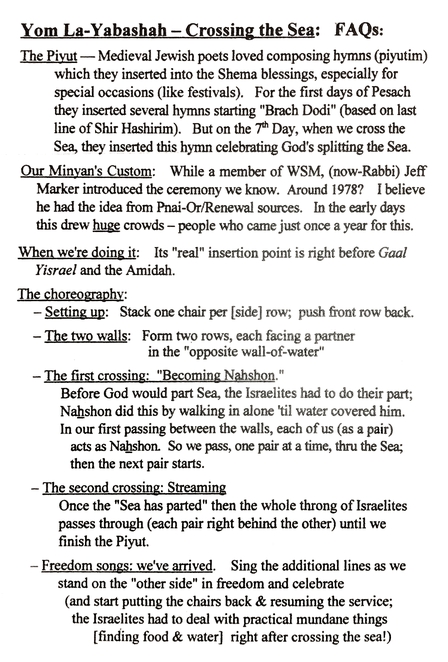
A ritual for the Seventh Day Pesach
reenactment of the Crossing of the Reed Sea can be found
in Joe Rosenstein's Siddur Eit Ratzon, on page 133.
Download the songs: optimized for screen viewing or optimized for printing.
Minyan history
"Return to a New Place" — Sheyna Mueller's 1984 thesis about the West Side Minyan (BIG download)
Ansche Chesed 160th Anniversary Journal (1989). Includes many mentions of the West Side Minyan and its role in the revitalization of Ansche Chesed, as well as pictures of some Minyan members of that era.
Glossary
- Aliyah
- Being invited to say the blessings before and after
a passage is read from the Torah. If you need help with
the Hebrew, just tell the gabbai. The person called up
(e.g., you) is the oleh.
- Bentsch
- To say the Grace After Meals (Heb.: Birkat HaMazon).
- Chumash
- A printed book containing the weekly Torah and Haftarah
readings.
- Davener
- In WSM usage, one who leads the prayer service. Elsewhere,
the same role might be called a Baal t'filah or
Sh'liach tzibur.
- DT
- D'var torah -- a brief talk about the week's
Torah or Haftarah reading, followed by a Torah Discussion.
The person giving the talk and leading the discussion
is also called the DT. Outside the WSM, a Torah Discussion
is rare, the DT might be called a D'rash, and the
person who gives it could be the Darshan.
- Gabbai
- One or two people who officiate during the part of the
service when the Torah is read.
- G'lilah
- The honor of rolling and dressing the Torah scroll after
the reading. It's a great honor but requires no Hebrew.
- Gomeil
- One who has returned from a long trip, recovered from
an illness or faced recent danger might choose to say
the gomeil prayer ("bentsch gomeil"). If you'd
like to, speak to the gabbai.
- Haftarah
- A reading from the Prophetic books of the Bible, done
after the chanting from the Torah scroll.
- Hagbah
- The honor of lifting the Torah scroll after the reading.
Requires upper body strength.
- Kiddush
- After services, a social gathering with snacks; also
the blessing over wine. Thus, one says kiddush (the blessing)
at the beginning of the kiddush (the gathering).
- Leining
- Chanting from the Torah scroll. Can also refer to the
portion chanted ("What's this week's leining?").
The person who chants is the leiner.
- Maftir
- The last portion of the weekly Torah chanting or the
person who recites the blessings for it.
- Siddur
- Prayerbook
- Yad
- Wood or metal pointer used in reading from the Torah
scroll. Sometimes an oleh is asked to use the yad to follow
the reading in the Torah scroll. If you can follow the
Hebrew prayers in the prayerbook, you should be fine.
Otherwise, just ask the gabbai to find someone else.
|